
How to Make Gumbo
the original one pot meal

I may be slightly unqualified to write this, but after making gumbo ~20 times, and eating at least 500 bowls of it, I’ve got a pretty good idea of what I’m doing. We can let The Mimi determine how I did.
Gumbo is one of my favorite meals, and it has been for a long time. When visiting my Louisiana grandmother as a kid, it was always on my list of requested dinners. In the last few years, I’ve taken a new approach when visiting and have tried to learn how Mimi makes a gumbo, hoping that I can carry on the tradition of this great meal. In an era of frozen dinners and DoorDash, family recipes are falling through the cracks. It’s a real shame. I think that it’s worth the effort to learn these recipes so we can carry on the legacy of those who fed us over the years.

The history of gumbo is hotly debated and powerfully connected to the history of the region it comes from. While not getting too deep in the weeds, I’ll do my best to provide a summary.
Southern Louisiana is a melting pot of West African, French, German, and Spanish immigrants. Additionally, there are the indigenous folks who resided here before settlers and slaves arrived. Gumbo is a product of this unique cultural combination. While scholars dispute the origin of the dish’s name, the majority attribute it to the word gombo, which means okra in a few different West African languages. Okra was a staple ingredient in the dish in its early days, thanks to its ability to act as a thickener and the plant’s affinity for the Louisiana climate.
The dish itself is thought to be a take on bouillabaisse, a French fish soup. The detractions from traditional bouillabaisse may come from collaborations between early French settlers and Native Americans, who knew how to eat the edible plants of the area.
Next, a combination of Spanish fishermen hauling in large catches from the Gulf of Mexico and German sausage makers bringing their craft to the region added to the “everything but the kitchen sink” style of gumbo. Pile on a few hundred years of iterations, and we are left in 2025 with the modern-day gumbo. In every house between Morgan City and Lafayette, you will find a different recipe and different rules. Some add okra, others hate it. Some use filé, others don’t. Some add seafood, others don’t! You get the point.
My gumbo is chicken and sausage. One day I may try other varieties, but for now this is what I like. And, it’s what I grew up with. Food has the ability to be fuel for our souls and bodies. When I make gumbo, I’m eager for some soul food. Something that connects me to a tradition much larger than myself. Chicken and sausage does that for me. You pick what works best for you!
Below is my best attempt at conveying how I make gumbo. I’ll be curious to hear from those of you who give it a try. If you run into any issues, just call me, considering most of you have my phone number. I hope you enjoy!
Chicken and Sausage Gumbo
Step 1: Before you can even consider starting your gumbo, you need to do some prep work. Begin by making or acquiring a stock of your choosing. I like chicken stock. Pro tip: get a rotisserie chicken, debone what you can, then place the entire carcass in a pot, cover it with water, and boil it until all the meat comes off. Add the meat to your meat pile and discard the bones. Save the stock and allow it to cool off. If you don’t go this route, you can use store-bought chicken stock.
Step 2: Prepare your Holy Trinity. The trinity, as it is called in Cajun cooking, is finely chopped celery, green bell pepper, and onion. For our gumbo, we are using one and a half celery stalks, one average-sized green bell pepper, and one medium onion. Adjust this as the size of your gumbo changes. Chop these up and set them to the side. I use a Cuisinart and I’ll never go back to chopping.
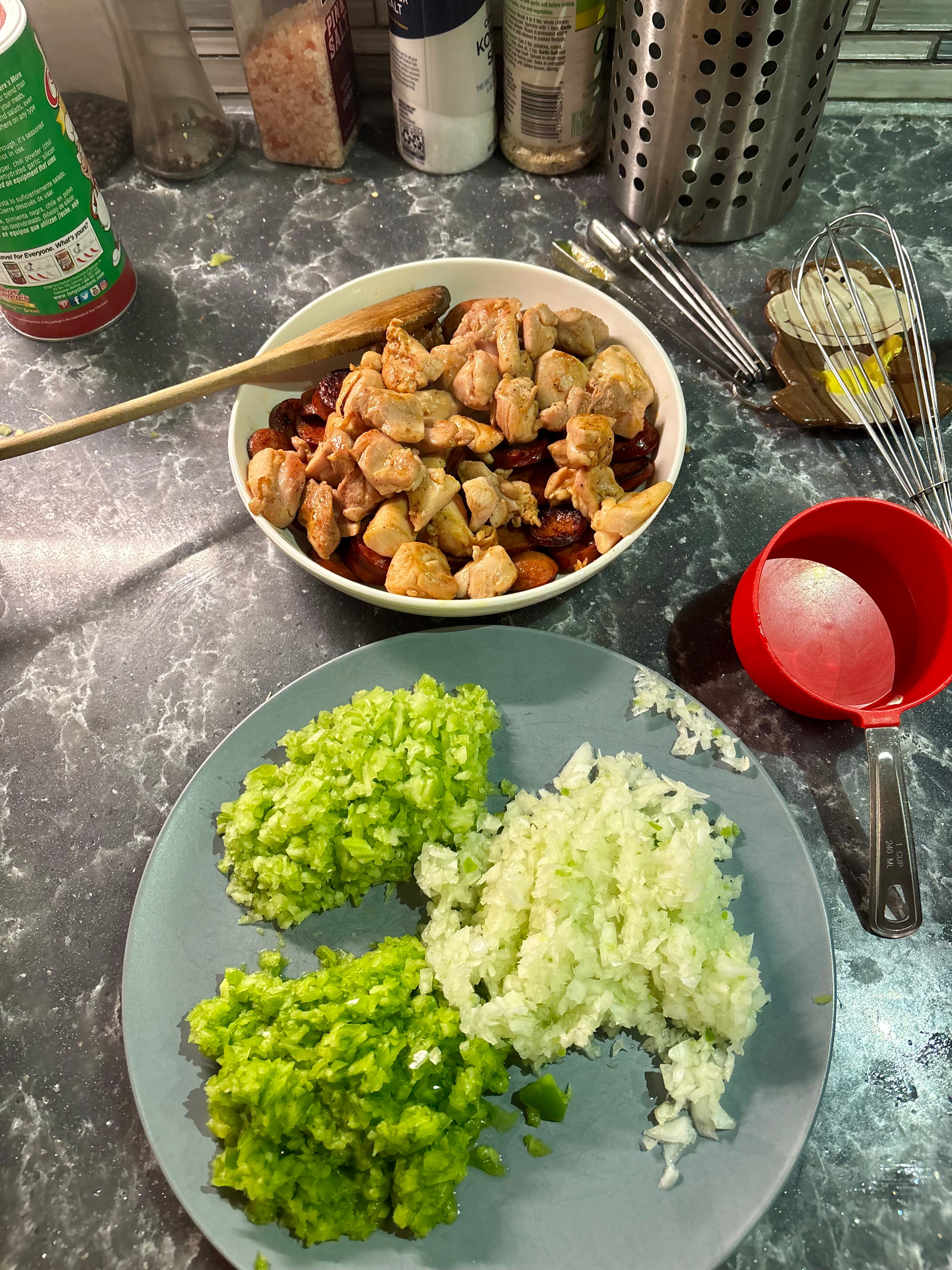
Step 3: Brown your sausage in a cast-iron pot. This pot will be the same one that you make your roux in. Slice your sausage into ¼ inch chunks. For this recipe, I like one and a half links of sausage. I use andouille for the spice, but you can use any smoked sausage. Get the ones that are horseshoes. Hillsdale Farm makes some varieties that you can find at most grocery stores. To brown, get your pan hot and add your sausage chunks. Don’t overload the pan; you want a nice crisp on each piece. Once you’ve done this, remove the sausage and set it to the side.
Step 4: Now, the fun begins. We’ve laid the groundwork for a successful gumbo, but it’s time to make the key ingredient, a roux. In your cast-iron pot, add ¾ cup of high-smoke-point, neutral oil. Lard is what the original Cajuns would have used, now a a days you can use vegetable, peanut, or grapeseed. Then, add ¾ cup of white flour. Using a wooden spoon/spatula, stir this mixture over a medium/low heat. It’s important to note that when you start this step, you are committing to standing in front of your stove for thirty minutes to an hour. Barring the death of a close relative, you cannot leave this roux.
As you stand there, stir, stir, stir, stir, and guess what, stir. Hey! Just don’t stop stirring. Your goal is to heat and stir this roux and take it from the color of white flour to a deep peanut butter brown. If you stop stirring, you will burn the roux and have to start over. The darker the roux, the more flavor you add. At the same time, as the roux gets darker, it will get darker more rapidly. Which, I think this is the scientific definition of acceleration? The last fifteen minutes of making a roux can be incredibly exciting, like the fourth quarter of a close game.
A brief side note: Making a roux is the hardest thing I have ever done in cooking. Not only does it take time, but it takes a divine understanding of what you are looking for. Most of my early roux’s were too light and failed to add the quintessential gumbo flavor. Take your time and know that the first few will not turn out the way you want, and that’s okay.
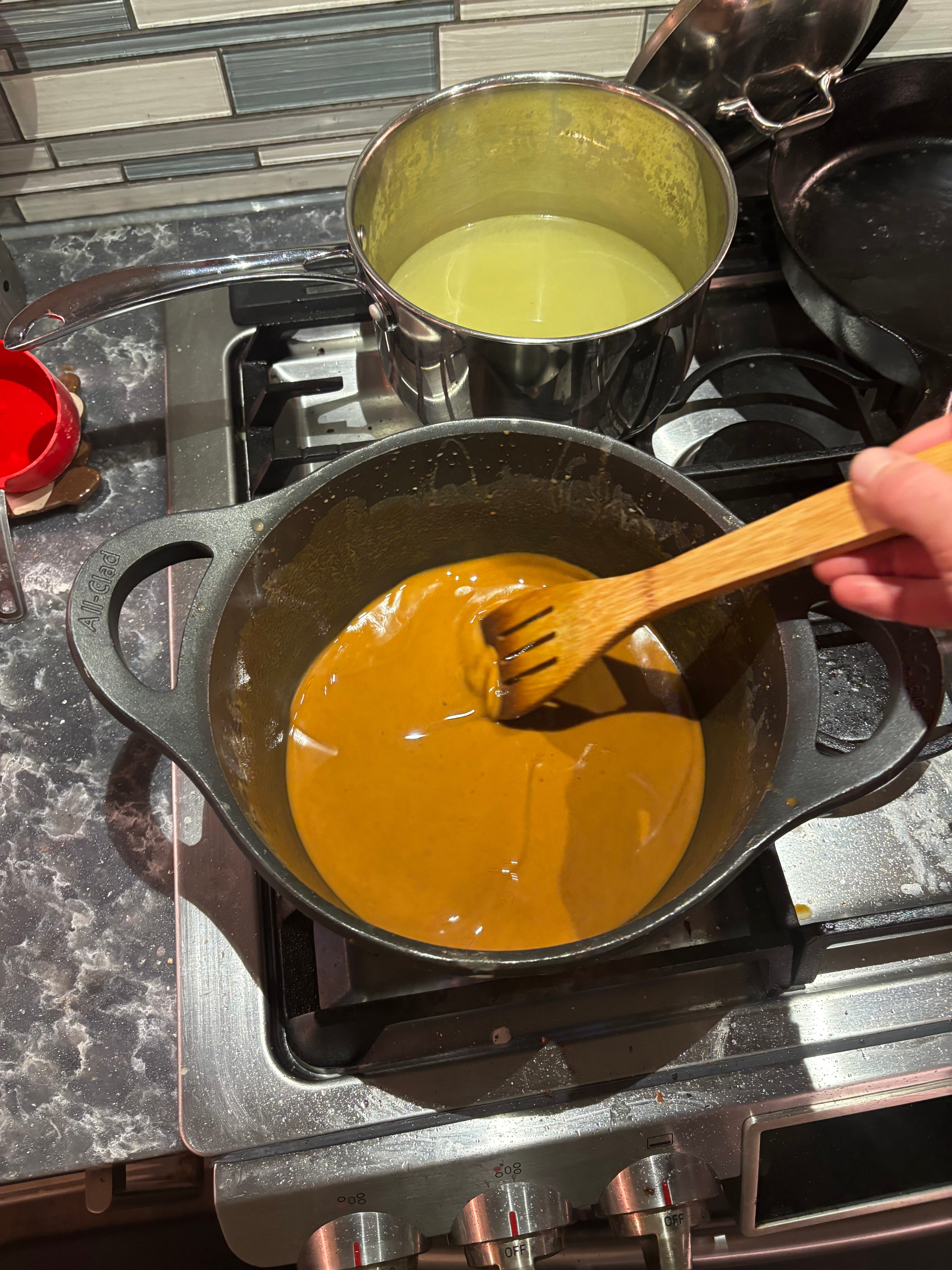
Step 5: Once the roux is dark to your liking, it’s time to stop the cooking. This is when all that preparation matters. In order to stop the cooking, you add your trinity all at once. This will steam and sizzle an incredible amount. DO NOT STOP STIRRING. You are still in the danger zone and must keep everything moving. I stir for another ~10 minutes and really let the trinity sweat to release its flavor onto the roux.
Now, if you’ve been paying attention, you’ll notice that we have yet to add any salt, pepper, or spices. That is intentional. Your true seasoning from a gumbo comes from the roux and the trinity. That being said, we’re finally ready to add a bit of seasoning. With my gumbo, I use one thing: Tony Chachere’s. Begin with a light sprinkle across the top. I’m not sure how much, maybe half a teaspoon. Not much, though, we are going to slowly layer seasoning throughout the cooking process.
Step 6: Next, begin slowly adding your stock. The slower you add it, the better the flavor profile and the thicker the end product is. Nothing should be done fast when making gumbo. Take your time adding half to one cup of stock at a time and continuing to stir. Add enough stock to achieve the level of consistency you want; you can always add more later. I’d shoot for something slightly thinner than gravy.
This is another point to maybe add some more Tony’s. You can also start to taste here. The key when tasting is to understand that you’re not yet looking for a finished product. It should taste like the roux and the various elements, but they’ve yet to all come together. Avoid applying heavy seasoning.
Step 7: Add your meat! Dump all that delicious browned sausage and chopped chicken into the pot and stir it up. Fold everything together and bring it to a light simmer. You may want to add some more stock if it’s looking a bit thick. Taste and season again (if needed.)
Step 8: At this point, it’s time to step back from the stove and let all the elements of our gumbo fall in love. Cover it and let it roll over a low simmering heat. Return every now and then to taste and maybe add more seasoning. As you taste, you should notice the flavors coming together and making a true gumbo flavor profile.
Serving: Gumbo tastes best the day after you cook it, so I recommend letting it sit in the fridge overnight. This also gives you the chance to remove some of the fat, which will separate to the top. Serve your Gumbo over rice with some parsley or green onions as a garnish. Keep in mind that this is not a rice dish. Therefore, use a small amount of rice. In my family, we always have homemade potato salad on the side. The combo of the two is to die for.
Pairing: Gumbo goes good with most beverages. Your classic lager, be it Rainier, PBR, or the microbrew variety, will do well. For wine, I like a New Zealand Sauvignon Blanc, but a Riesling or light red like a Pinot Noir will also work.
That’s all, folks! Get your people together and share this delicious meal with them.
Oh yeah… thank you for reading :)
Beautiful instruction and description Cliff…. My mouth is watering! You’re in charge of the Christmas gumbo!!!👨🏼🍳❤️
Looks great! Love a good gumbo. My favorite descriptor for a gumbo roux is “a two beer roux” — meaning, it’s done after you finish drinking your second beer while you stir it.